
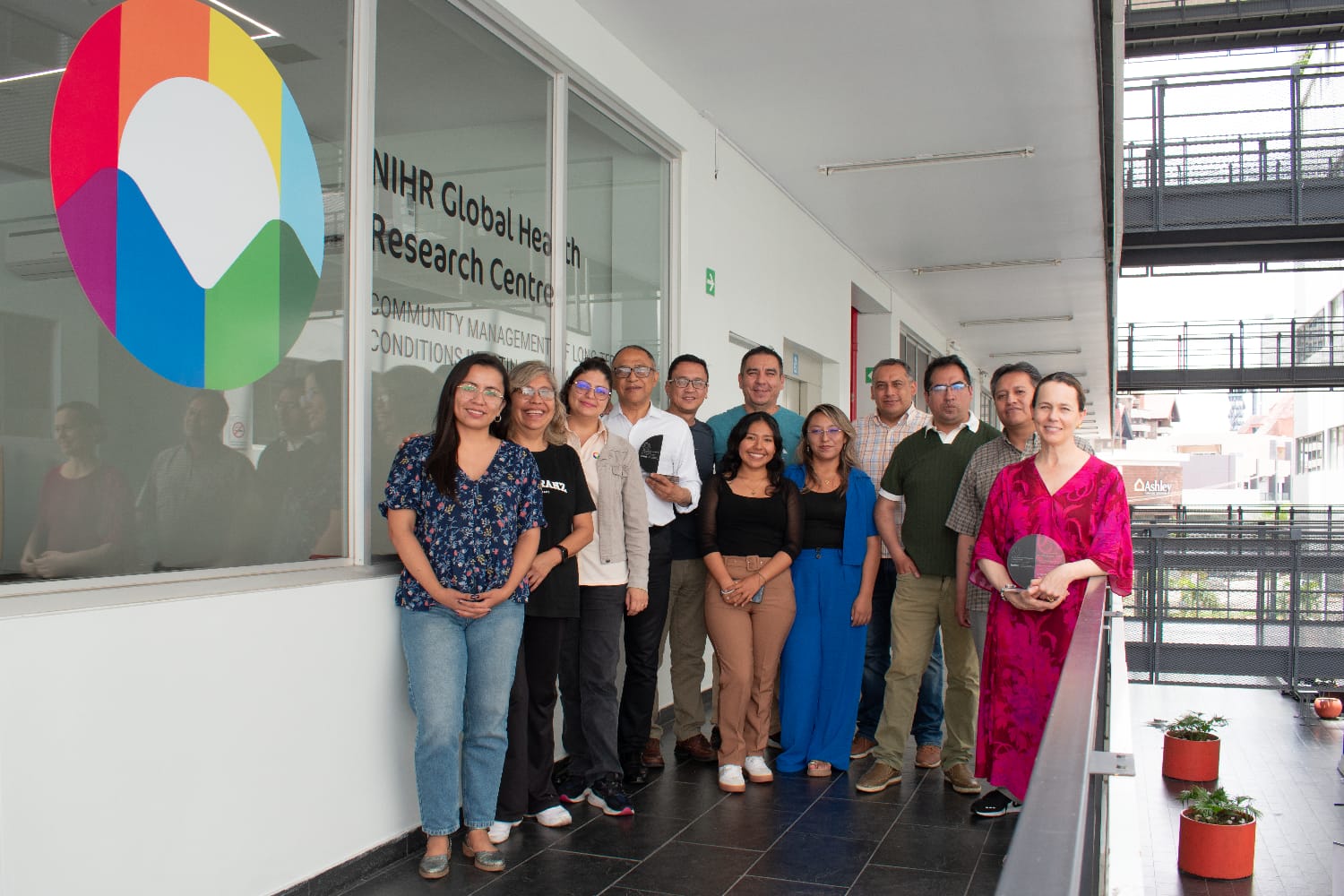
At the NIHR Global Health Research Centre, we are committed to strengthening research with quality, responsibility, and respect. For this reason, the creation of Ethics Committees in Latin American countries is essential to ensure that high standards are upheld in scientific processes.
As part of this effort, in 2025 the Research Ethics Committee was established at Universidad Unifranz. This team will be responsible for evaluating, supporting, and supervising health research projects in the country, as mentioned by Dailyn Llanos, President of the Research Ethics Committee.
“The Ethics Committee has the role of ensuring that all research protocols and projects maintain the ethical and academic rigor required for them to be carried out.”
Supporting this process, ethics and bioethics specialists from the Pontificia Universidad Javeriana in Colombia trained the committee members to strengthen their capacities in regulations, ethical evaluation, and good research practices.
Dr. María Margarita Manrique, Director of the Research Office at HUSI in Colombia, explained the importance of these committees in research:
“Ethics committees are key actors in the clinical research process. They must ensure the ethical criteria that allow this type of research to be implemented. Their function is to guarantee that projects comply with essential principles such as scientific and social value, justice, risk–benefit balance, and respect for participants through processes such as informed consent.”

In Latin America, it is essential to continue strengthening the capacities of researchers in order to promote the scientific and social development of the region, as well as to inspire new generations to become involved in research.
Dr. Eduardo Díaz Amado, a bioethics specialist from Pontificia Universidad Javeriana, reminds us that we live in a world shaped by science, although we often do not realize it.
“Just look around us. We are surrounded everywhere by devices, information systems, ways of doing things, medicines, and procedures. We are constantly researching because this is a world that is based precisely on that. I think that perhaps young people need to realize something very obvious—that research is the fundamental basis of all the developments we have in society.”
Ethics is a fundamental component in the development of scientific research, especially when it involves people, communities, or the management of sensitive information. This is particularly important in a hyperconnected era where large amounts of unverified information circulate, which in many cases may pose risks to research.
For this reason, Dr. Nelson Castañeda, professor at the Institute of Bioethics and trainer of the committee, highlights that the creation of these spaces is essential to strengthen trust in science.
“Science is built upon standards that generate trust in the results of scientific research, especially at a critical moment when there is a loss of trust in science and researchers, where post-truth, manipulation of information, and the creation of errors presented as truths have gained ground.”

The consolidation of this committee represents an important step toward strengthening research in Bolivia and continuing to build a regional network of knowledge in global health, promoted together with the NIHR Centre.