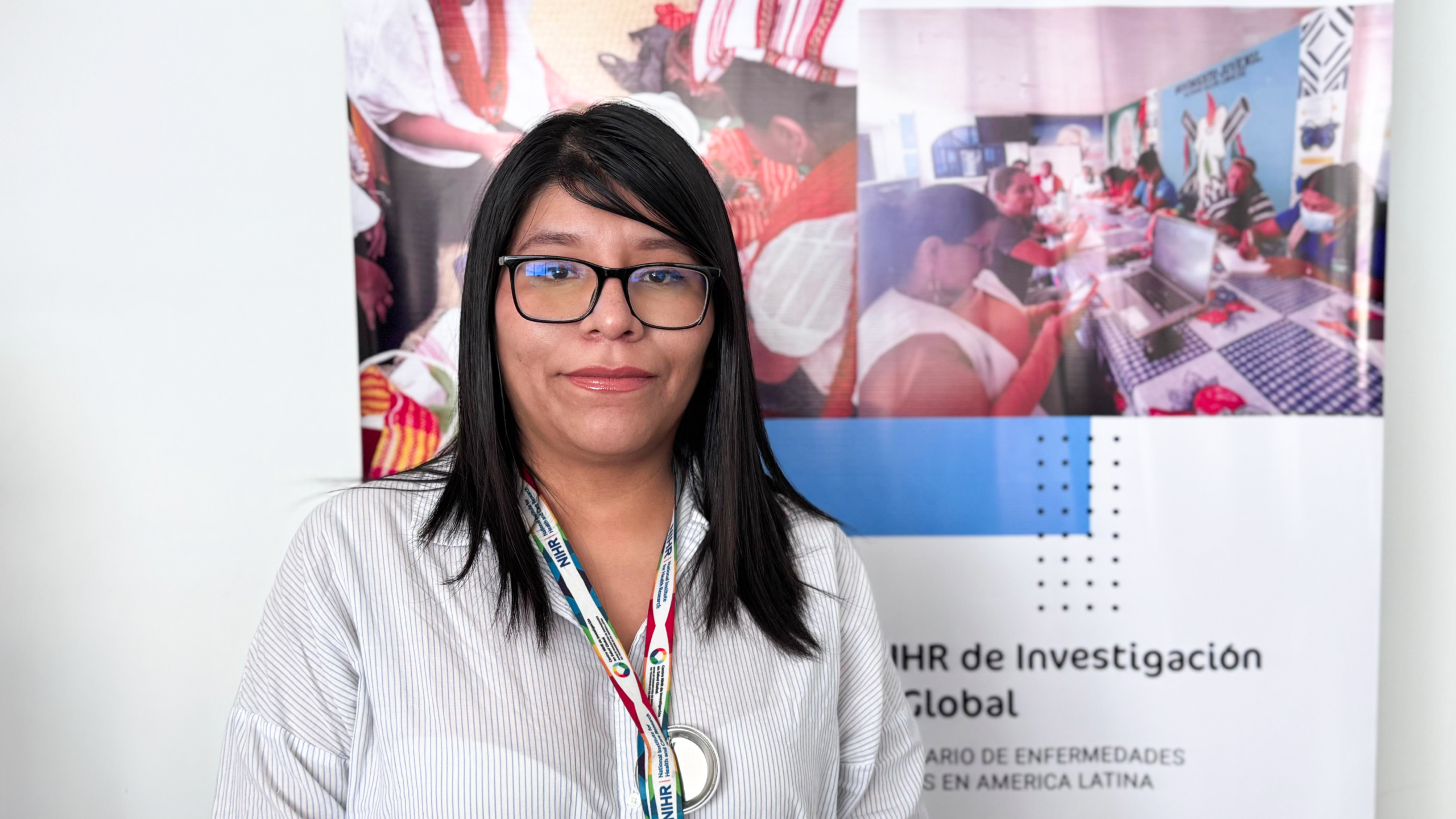
Health research doesn’t depend only on data—it also depends on people who can analyze it, question it, and turn it into useful information for society. Today we introduce one of the young researchers from the NIHR LatAm Centre Bolivia, Livia Khana Chávez Andrade, who is about to begin her Master’s degree in Biostatistics at Pontificia Universidad Javeriana in Colombia.
What has been your role within the NIHR LatAm Centre?
I am a research assistant at the NIHR LatAm Centre Bolivia, and I have worked across different components, such as research, peers and volunteers, and the multifamily component. I have also participated in community engagement and supported the training of doctors on how to use the cultural mapping catalogue.
In addition, I’m part of the MEL team, where I contributed to the development of dashboards and data visualization documents.
What challenges and opportunities exist in biostatistics and research?
Biostatistics is a complex field and still not widely explored. I know there must be people like me—people who studied medicine and don’t want to stop there, who want to learn much more, apply other types of knowledge, or work in research. And if you enter the research field, you have many doors open—especially for women in STEM. There is much more inclusion now than before. You will definitely find barriers, but you will also find more opportunities.
What does it mean to you to have obtained this biostatistics scholarship?
It’s a dream come true. In fact, I started this job because I was going to apply for the biostatistics scholarship. For that, you need to know a bit of biology, medicine, health, and mathematics—it’s a complex mix, but it’s exactly what I wanted.
Since my second year of medical school, I could already see myself analyzing data and doing research, and that’s how I’ve progressed. Then, when I was in my fifth year, I realized that biostatistics existed.
Why did you choose Pontificia Universidad Javeriana for this academic experience?
My initial idea was to apply for “Becas Frontera” in Chile, but this opportunity came up, so I’m going to Colombia, to Pontificia Universidad Javeriana, which is one of the best universities in Latin America.
What do you hope to learn or strengthen during your training in Colombia?
I want to clarify that I’ve learned many things here—I know quite a lot about biostatistics—but you reach a limit. You can learn from the internet, books, and so on, and it feels like I’ve hit a ceiling. I want to go and break through that ceiling.
I know a lot about mortality analysis, but I want to learn much more. I want to learn even more about how to visualize census data, how to work on incidence and related areas. There are many things I want to learn, and I know they will teach me at Javeriana. I’ve been researching the professors—even “stalking” them a bit—and I realized they have much more knowledge than I do, and they will be able to help me achieve this dream.
How do you imagine applying this knowledge when you return to Bolivia?
At the NIHR LatAm Centre there is a lot to do, because now we’re going to have a lot of data—a large amount of information—and we need to know how to analyze it.
The idea is that, with everything I learn, we can apply it, I can teach the other members, we can sustain this knowledge over time, and do much more with the data we have.
Besides that, another one of my dreams is to teach. I want to share everything I’m going to learn, because I feel Bolivia needs this knowledge. If we identify what we currently don’t know, I believe we will be able to improve much more.